In my Advanced Writing class this morning, I experienced one of those rare moments that teachers live for. The class is small, only 6 students. This being Japan, the 3 young men sit on one side of the aisle and the 3 young women on the other. The students are busy with the final stages of the research papers they've been working on all semester.
One of the students was using a quotation, and I noticed that there was a quote within a quote. In my usual serious way of teaching, I said to him in a stage whisper, "I'm going to teach you a secret about using quotation marks, but don't let any of the other students know, OK?"
Naturally all the ears in the room perked up, and everyone listened in as I explained the usage of single quotation marks for a quote within a quote. As soon as I had finished, they all dashed over to his desk to find out the "secret" information. Peering over his shoulder, those who understood the usage were explaining it to others in Japanese.
I wish I had captured the moment on camera - students crowded around a desk, excited about learning and cooperating to help each other understand. If I had simply "taught" the usage by lecturing about it, about half of them would have been listening, and fewer than that would probably have gotten it right. As it is, I think they'll all do it correctly if their paper happens to include a quote within a quote.
The "secret information" technique is not one I use every day, but it certainly was successful this time, and I'll keep it in my bag of teaching tricks. The success of getting the information across was not, however, due only to a teaching trick. It also took a class that was comfortable with me and students who had bonded. That together with an unusually enthusiastic group is what made the moment.
Wednesday, December 06, 2006


Saturday, December 02, 2006
I Can't Stop!
In 2 of my English conversation classes, I'm using a textbook called Impact Topics. This week, class discussion stemmed from one of the most popular chapters, entitled "I Can't Stop", which focuses on addictions.
In both classes, I made a couple of discoveries. One is that the students don't really understand the concept of addiction. A couple of them who have part-time jobs and work 5-6 days a week thought that they were workaholics. I explained that, unless they continued to work beyond the number of required hours and to do extra work without pay, they weren't really workaholics.
I gave the example of what happened the previous week when a couple of my TOEFL students asked me about the difference between "only" and "just." I ended up spending about 6 hours researching the two words on various Internet sites, coming up with several pages with numerous examples of usage. I'm still not satisfied that I can give a clear explanation and will most likely spend more time on it. Now that's a workaholic! (It's also the reason I haven't been doing my duty as one of the teachers at the ESL Help Center at Dave's Cafe. I simply was spending too much time except on the simplest of answers.)
After my discussions with small groups and talking with the entire class about the nature of addiction, many of the students (if not all) had a much better understanding of the difference between liking something (such as watching movies, which many of them enjoy) and being addicted (watching movies for hours and hours, often until the wee hours of the morning, interfering with their studies and/or work).
I always start out the class by telling them how I'm a chocoholic, and explaining other "holic' terms such as shopaholic. At the end of the class, I ask them what addictions listed in the text they think I've checked besides chocoholic and workaholic. They can usually guess surfing the Net fairly quickly, but it takes a while for them to guess alcoholic. In fact, today there were numbers of different guesses, and one student finally came up with "drinking alcohol." When I said, "Yes," there was a cry of astonishment.
I told them how I used to drink a great deal, a bottle or two of wine, every night, which they found hard to believe. I also explained quickly that I was a recovering alcoholic, through the help of a support group, and that I hadn't had a drink for well over 8 years. I added that I could never drink again, even a single glass of wine.
Students fill out Self-Assessment Forms every week where they can give feedback on what they found interesting in their group discussion, and can ask me questions. I somewhat expected some comments on my self-disclosure about my alcoholism. To my astonishment, not a single student in either class mentioned it. Most of them focused on their own possible addictions or those of others in their group. Some felt they might be addicted to something (a common addiction was use of cell phones) and others came to the conclusion that they weren't. My openness about my own addictions seemed to give them more permission to talk about their own concerns.
Although I always talk briefly of ways of getting help with one's addictions - everything from hot lines to professional counseling to (peer) support groups - very little of their discussion seems to get into those areas. Last year, however, two of the students who smoked decided to start their own quit smoking support group of two. For others, if they need to seek help some day, at least they've been introduced to the concept of support groups.
Sunday, November 26, 2006
Fake Priests in Japan
This is with regard to a BBC "news" story, Faking it as a priest in Japan, was published on the BBC Asia-Pacific site November, 2, 2006.
The first time I met Mark Kelly in the part-time university teachers' room, he mentioned his "side job" as a wedding minister. He seemed to do so almost apologetically and wasn't forthcoming about the details. I sensed, and later discovered, that he was not actually an ordained minister. That's why I'm surprised that he was so candid about his experiences with a freelance journalist, Kathleen McCaul.
I am even more surprised that, out of whatever news organizations she may have contacted, the BBC was the only one to accept her "story." From what I know, Mark only spoke to her casually when she travelling through Japan. Her whole report was anecdotal. She didn't get any statements legitimate sources, such as the wedding company for which Mark worked.
As far as I'm concerned, it was totally unethical of the BBC, as well as the reporter, to print anything that was off the record and dubious, at best. Going for the sensational is not up to former standards held by the BBC. Furthermore, since they are claiming they don't know who is telling the truth, the reporter or the source, they are not printing an apology or retraction of any sort.
Whether such fake priests are in existence is a whole other issue. While I would think there would be an appeal to traditional Shinto wedding ceremonies, couples these days seem to find it romantic to get married in a chapel with stained glass, a bell, ribbons on the pews, and foreign man [sic] dressed in a robe. Most aren't concerned with the Christian aspect. The decorative aspect is what counts, much like the colored lights, Santa Claus suits, and Christmas trees that start making an appearance in mid-November in department stores and supermarkets, along with such delightful numbers as "Jingle Rock" and "I Saw Mommy Kissing Santa Claus." A bit of a return to Saturnalia.
This is not just an occurrence in Japan. There are certainly Americans who don't consider themselves Christians who celebrate Winter Solstice, not only with lights but perhaps even with an Xmas tree, and the exchanging of cards and gifts. As for weddings, my Unitarian Universalist minister in Racine, Wisconsin, was often asked by couples to perform ceremonies for those who wanted to be married in a church, but who didn't necessarily want a Christian ceremony. The only difference is that, in the U.S., someone with official standing must sign the wedding certificate, but it could be by any Justice of the Peace as well as someone was who had a "mail order" ordination.
What I'd really like to see explored is the number of fake English teachers in Japan. There are far more of them than there are fake priests!
Thursday, November 23, 2006
37th National Day of Mourning
 The 37th National Day of Mourning was held on Thursday, November 23, 2006, at 12 Noon on Cole’s Hill (the hill above Plymouth Rock) in Plymouth, Massachusetts. It was sponsored by the International Action Center.
The explanation of the event on the website is: "An annual tradition since 1970, Day of Mourning is a solemn, spiritual and highly political day. Many of us fast from sundown the day before through the afternoon of that day (and have a social after Day of Mourning so that participants in DOM can break their fasts). We [the United American Indians of New England] are mourning our ancestors and the genocide of our peoples and the theft of our lands. NDOM is a day when we mourn, but we also feel our strength in political action. Over the years, participants in Day of Mourning have buried Plymouth Rock a number of times, boarded the Mayflower replica, and placed ku klux klan sheets on the statue of William Bradford, etc."
From a speech by Moonanum James on the 32nd National Day of Mourning, 2001: "The greatest single acts of terrorism to date were not perpetrated by Osama bin Laden, but by the US military when it dropped atomic bombs on the people of Hiroshima and Nagasaki."
Friday, November 17, 2006
Fast for a World Harvest
"More than 850 million people suffer from chronic hunger," according to Oxfam America. "In the US alone, almost 36 million people live in poverty. Globally, 30,000 children under the age of five die every day, mostly from preventable causes, including malnutrition.
An email I received from The ONE Campaign to Make Poverty History stated, "The problem isn't a lack of food. We have more than enough to go around. The problem is the distribution, something we, with other countries around the world, can be the first generation to fix."
Suggestions to raise awareness include participating in a Hunger Banquet on the Thursday before Thanksgiving (in the U.S.).
If the banquet included 20 people at the table, representing the world’s population:
The true power of an Oxfam Hunger Banquet is that as you eat your meal, unlike the real world, you see what’s on everyone else’s plate.
 Another suggestion is to Skip a Meal for Oxfam. This helps to make one more conscious of the number of people all over the world who go without meals. The money saved can be contributed to Oxfam.
A third option, that could be used by teachers for their students or parents for their children (as well as for themselves), is to play the Hunger Game. One "sits" at a banquet table, but the luck of the draw could mean either feast or famine.
The site also includes a Hunger Quiz and some "Recipes" for Change.
Although I accessed this information too late to bring it to the attention of my students in time to participate this year, I will certainly include the "games" in future lesson plans. In fact, in Japan the Hunger Game may be more appropriate at New Year's, which is generally a time for feasting on traditional food. Older generations, who grew up during or just after World War II, may well remember when there was little on the table besides course grain and pumpkin.
An email I received from The ONE Campaign to Make Poverty History stated, "The problem isn't a lack of food. We have more than enough to go around. The problem is the distribution, something we, with other countries around the world, can be the first generation to fix."
Suggestions to raise awareness include participating in a Hunger Banquet on the Thursday before Thanksgiving (in the U.S.).
If the banquet included 20 people at the table, representing the world’s population:
- 3 would be served a gourmet, multi-course meal, while sitting at decorated table and a cushioned chair.
- 5 would eat rice and beans with a fork and sit on a simple cushion.
- 12 would wait in line to receive a small portion of rice that they would eat with their hands while sitting on the floor.
The true power of an Oxfam Hunger Banquet is that as you eat your meal, unlike the real world, you see what’s on everyone else’s plate.
 Another suggestion is to Skip a Meal for Oxfam. This helps to make one more conscious of the number of people all over the world who go without meals. The money saved can be contributed to Oxfam.
A third option, that could be used by teachers for their students or parents for their children (as well as for themselves), is to play the Hunger Game. One "sits" at a banquet table, but the luck of the draw could mean either feast or famine.
The site also includes a Hunger Quiz and some "Recipes" for Change.
Although I accessed this information too late to bring it to the attention of my students in time to participate this year, I will certainly include the "games" in future lesson plans. In fact, in Japan the Hunger Game may be more appropriate at New Year's, which is generally a time for feasting on traditional food. Older generations, who grew up during or just after World War II, may well remember when there was little on the table besides course grain and pumpkin.
Thursday, November 09, 2006
Peace Pulse
I have recently installed the Peace Pulse on my computer. Every hour on the hour, there's a chime as a reminder to pause for a minute of silence, contemplating peace in one's own life and in the world. Another chime rings at the end of a minute.
The chime, which can be downloaded at
The chime, which can be downloaded at
Saturday, November 04, 2006
Getting Vetted
The following post is written by Mac (the cat).
 This morning we had an adventure! We didn't know what was happening at first. Mommy put Tippy in our carrier, but he really didn't want to be there, so he pulled at the door until he got it open and escaped. Then she grabbed me and put me in, but when she put Tippy in again, I got out. Then she tried to put me in again, but we both escaped. Since Mommy's bigger than both of us, she finally got both of us in. Our adventure began!
First she took us into the hall and down the stairs, where we almost never get a chance to go, but we were in the carrier so couldn't run up and down the stairs playing. Then we got into the back of a car driven by a man who smelled a little like smoke. We haven't ridden in cars very much, and I think it's pretty exciting, but Tippy was scared so he buried his head under my arm.
Then Mommy took us into a small building and put us on a bench. There was a nice lady talking to Mommy, but on another bench was a dog. I've never been so close to a dog before, so I watched him closely. He was really quiet, for a dog, and just sat there with his person, but I was kind of glad we were in our carrier.
Soon a man in a white coat invited us into his room. I remembered him from the smells. He opened the carrier, so I had a chance to get out, but Tippy just stayed in a corner of the carrier. The man put me on a table where he was touching and pushing me, and then he put something in me that kind of pinched. It didn't really hurt much, and he seemed like a nice man, but I made a few noises just so he'd know I didn't like all that touching. Mommy and another nice lady were holding me and talking to me, so I felt pretty safe.
 Then they put me back in the carrier and made Tippy come out. I could tell that Tippy didn't like it, but he was really quiet. I was on the floor and couldn't see what was going on, so I made a few noises.
Tippy got back in the carrier with me and curled up against me. Actually, I curled up against him, too, because I was still a little scared and I didn't know what was going to happen next. We got in the back of another car driven by another man, and soon Mommy was carrying us up the stairs. We were home again! Tippy and I walked all over the room, sniffing and checking to see if everything was the same.
An adventure to another place can be pretty exciting, but home is the best place of all!

Friday, October 27, 2006
Don't push too hard
What do a mechanical pencil and an iPod have in common. Both of mine broke down this week. Or, at least, I thought they did.
In the case of the mechanical pencil, it turned out that I was pushing too hard (not being able to read the warning written in Japanese on the side). The lead comes out by pushing GENTLY on the cap. Whenever I use mechanical pencils, I also tend to push so hard that the lead breaks, so I need to practice writing using a lighter hand.
As for the iPod, nothing was showing up on the screen, even after pushing on all the possible menus, turning the wheel numbers of times, and making sure the batteries were recharged.
During my lunch break, I rushed to the Apple store (10-15 minutes away by subway) and ran in more or less shouting that my iPod had died. I was stumbling my way through a long explanation in Japanese when the English-speaking "genius" at the genius bar calmly handed it back. It was working!
"How did you do that?" I exclaimed.
"You push on the center button for 5 seconds," he explained (not adding GENTLY, but I knew that a soft touch was all that was required.)
I muttered a quick thanks, adding "5 seconds" in Japanese, and ran out of the store, explaining that I had a class that started at 1:00.
I think the message is that I may be pushing too hard in my life!
Wednesday, October 25, 2006
Laws Enacted by My Students
In my class at Fuji Women's University, the topic for the day was what should be prohibited. The example in the text was about smoking, and we talked for a bit about how the rules against smoking were gradually getting more strict in Sapporo. For example, it's no longer permitted on public transportation and even in the stations. What's more, downtown Sapporo now has big signs painted on the sidewalks prohibiting smoking and littering (a new word for the students).
In small groups, they then had to make school rules, then laws for the city, and finally laws for Japan. Here's a slightly edited composite of what they came up with:
School Rules
Laws for Cities (Sapporo)
Laws for Japan
In small groups, they then had to make school rules, then laws for the city, and finally laws for Japan. Here's a slightly edited composite of what they came up with:
School Rules
- No smoking in the school.
- No pets in school. (They said that included my cats!)
- Food and drinks should be allowed in class.
- No cells phones in class.
- No tardiness (being late).
- No writing on the desks.
- No sleeping in class.
- No reading magazines in class.
- No noise in the halls.
- Driving cars to schools should be allowed.
- No bullying.
- No stealing.
Laws for Cities (Sapporo)
- No parking on the streets.
- No crossing against the light.
- No littering, especially cigarettes.
- No hiding trash in the snow.
- People must buy their own trash bags.
- No smoking while walking, including in Odori Park.
- No abandoning animals or allowing animals to roam freely.
- Cell phones shouldn't be allowed on public transportation.
- No shoplifting.
- No graffiti.
Laws for Japan
- Going to school is required for 9 years.
- Getting a driver's license is allowed at age 18.
- No drunk driving.
- No illegal drugs.
- No drinking for minors.
- No smoking for minors.
- No sexual harassment.
- No domestic violence or sexual abuse.
- No cruelty towards children.
- No kidnapping.
- No illegal aliens.
- No polygamy (multiple marriages).
- No religious cults allowed.
- No stealing.
- No scams.
- No fraud.
- No sleeping during meetings of the Diet.
- No nuclear inspections. (I'll have to check what they meant by that one.)
- No killing people.
- No war!!!
Sunday, October 22, 2006
Doing My Civic Duty
I was surprised to receive an absentee ballot in the mail without requesting one (although I had done so for the last presidential election). Have I made the world a better place by filling it in and sending it back? I'd like to think so.
A couple interesting non-binding (whatever that means) questions were on the ballot. One was whether "the state senator from this district be instructed to vote in favor of legislation that would allow seriously ill patients, with their doctor's written recommendation, to possess and grow small amounts of marijuana for their personal medical use." Far be it from me to stand in the way of anyone's healing process.
Another was whether "the state representative from this district be instructed to vote in favor of a resolution calling upon the President and Congress of the United States to end the war in Iraq immediately and bring all United States military forces home from Iraq." I doubt if anyone currently in the West Wing is going to pay attention to any such resolution, but I was glad to see the question raised.
(Note: The color of the letters in this post is an indication of how I voted wherever it was possible, except for State Senator [where there was no candidate of color running].)
Saturday, October 21, 2006
Synchronicities
Some would simply call them coincidences. I prefer the term "synchronicities." It has a kind of Taoist sound to it. What I'm actually talking about is running into people unexpectedly. It happens so frequently in Sapporo that it almost be eerie if it weren't so very, well, Tao.
This evening it was when I was coming home from a conference in a suburb. I stopped in Sapporo Station for my monthly cheeseburger fix, and standing in line right in front of me was a student from yesterday's (Friday's) class, in fact, one of the guys who's most active in the class. (Aside: yesterday I got a kick out of watching the lightbulb flash over his head when he made the connection between "auditorium" and "audience," and practically shouted, "So "audience" means "listening people," which I affirmed.)
I had thought that would be my synchronicity for the day, but just as I was coming out of my subway station, I ran into a part-time teacher from the same university whom I haven't seen for a while (a piano teacher who studied in Hungary for a number of years). She said that she's teaching Wednesdays instead of Fridays this semester, which is why I haven't seen her.
Last week Sapporo Station was also the scene of a synchronicity when, after chorus rehearsal (held downtown that evening instead of at the concert hall near my apartment), I ran into a student who was in my TOEFL class at Sapporo University the next day. Then, the American exchange student who had been taking my Teaching Development class, also at Sapporo University, was riding on the same subway car. I think he was a bit embarrassed because he hasn't shown up for the class this semester. I didn't have time to ask him about it, since I saw him just as I was getting off, so I said, "Email me." He didn't. And the other student I ran into didn't show up for class this week. Oh, well.
A few weeks back, I went to a concert at Kitara Hall. The friend who gave me the ticket wasn't able to go, but when I was looking for a seat, a student from the educational university was in the audience. Her mother, who was with her, was kind enough to give up her seat so we could sit together and talk about her experience student teaching.
Going back to September, when I was on my way to Singapore (actually to the airport near Osaka where I would change to the plane for Singapore), another student from the educational university was on the same plane. That's five times I can think of when I ended up on the same plane as someone I know, going from or coming back to Sapporo. So I guess the chances of that happening are 5 in 1,800,000!
One of the more pleasant synchronicities, again in Sapporo Station, was running into a friend, Kathleen, and her husband, Terry, last August right after I had finished the audition for Sapporo Symphony Chorus. The experience had been so intense, and I really wanted someone to share it with, since my cats don't fully appreciate it. Kathleen and Terry made a great audience. What wonderful timing!
These are only a few examples of the synchronicities that I have at least once a month. I don't know what to make of them, although others in Sapporo have also told me how they seem to run into someone they know everytime they go downtown. In fact, a couple of my friends are convinced that the population of Sapporo isn't anywhere near 1,800,000. It's really more like 40,000, but the same people just keep moving around so that it gives the illusion of there being more.
If you're from Sapporo and have "synchronicities" like this, let me know about it!
Saturday, October 14, 2006
A Pioneer in Hokkaido, Japan
 A friend, Sally Kobayashi, gave a talk as a representative of the American Consulate about American "pioneers" in Hokkaido. I was one of the seven people chosen!
One reason she chose me is that I've been the only non-Japanese in Sapporo Academy Chorus for nearly 14 years, and I recently passed the audition for the Sapporo Symphony Chorus, again being the only non-Japanese.
She also talked about my doing hypnotherapy. As far as I know, I'm the only practicing English-speaking hypnotist in all of Hokkaido. Interestingly enough, although I intended to provide a service for those from English-speaking countries, nearly half of my clients have been Japanese, mainly seeking relief from stress!
Sally may have mentioned my forming SOAR, Sapporo Organization for Addiction Recovery, the only English-speaking support group for those recovering from alcohol or drug abuse in Sapporo or Hokkaido. Although we don't meet weekly, the few people who have come to a meeting stay in touch. In fact, a couple of us see each other at work. I don't know any other alcoholics in Sapporo who have "come out" about their addiction. Since Sapporo has such a small non-Japanese community, it takes courage. The main thing is that hope to reach others who may be seeking support.
Other pioneers included some people I know, one who has been a foster mom for more children than I can count; another who published The Couch Potato's Guide to Japan, the first book in English about TV; and another who started Project Santa, a volunteer organization that raises donations for child welfare homes.
Sally herself is a pioneer, who's written a book entitled Creating the Sapporo Snow Festival Sculptures. You can see Sally in the photo where she's speaking at the Edwin Dun Memorial Museum in Makomanai. She's considering writing a book about American pioneers in Sapporo and Hokkaido, of which there are many more.
Tuesday, October 10, 2006
Possible Nuclear Test in North Korea
This just in from the American Embassy in Tokyo:
On Monday, October 9, U.S. and South Korean intelligence services detected a seismic event at a suspected nuclear test site in North Korea. North Korea has claimed it conducted an underground nuclear test, but these reports are unconfirmed. The United States Government is monitoring the situation closely.
Comment by J.P. Scott (2006), who sends a satirical message daily from his website, The Daily Whale:
What do you think about North Korea's claimed nuclear test?
A. I can't figure out whether they faked it incompetently, or actually did it incompetently.
B. They're planning to deliver this bomb how? With the missiles that don't work?
C. Surprise increase in threat level, exactly as predicted.
D. Arright! Finally! The excuse for action!
Publish
Wednesday, September 27, 2006
Fun with TOEFL

The course was a joke to begin with, but that's another story (including why I have no textbook or CDs to teach with). I actually enjoy teaching TOEFL! And I guess students enjoy my teaching because four of them who have actually spent a year studying abroad were in my Sapporo University TOEFL class, which just started today. (They're the ones you see in the photo after I had a hypnotism session with a private class to help them concentrate and focus better during the exam, as well as feeling very relaxed.)
I was feeling a bit crazy during the class and, perhaps because I had students at a high enough level that they could understand, I couldn't stop cracking jokes. At the end of the class, I told the students, "I'll probably be here next week, if my tooth doesn't kill me." (My tooth is hurting badly because I still haven't had it capped after having root canal a couple of weeks ago.) Then I asked the students, "Which is the correct answer? (A) CA is coming next week. (B) CA is going to die next week. (C) CA has a tooth. (D) CA has no teeth." The students laughed. I imagine they'll be back next week, for more craziness, if nothing else.
Tuesday, September 26, 2006
Smelly Remedy for Sleepy Students
When I walked into class this morning, about half the girls had their heads on their desks resting. Granted, it's a 9 o'clock class (I myself have to get up at 6 a.m. to get to school on time), but I thought, "Oh, no. I'm going to be struggling with a bunch of sleepyheads."
What I did was to get out small aromatherapy kit that I carry around with me. Then I told them, they could choose "Energy," "Relaxation," "Romance," "Cleanse," or "Concentration." I went around the room, as each girl chose, holding a small bottle under her nose as she inhaled and leaving a drop of her chosen aroma just under the nostrils.
The atmosphere of the class changed completely, becoming totally charged with energy. There was a fairly even distribution in their choices, but what made the difference is that they all began talking (in Japanese) about the experience. I don't suppose any teacher had ever tried aromatherapy with them before! :-)
That and a jazz chant helped everyone wake up, and the students ended up having stimulating discussions. Ironically, the topic was Dreams!
Saturday, September 16, 2006
Talking with a Naprapath
Dr. Paul Mach, an expert in nutrition, visited our international women's group. At his site, The Center for Modern Approaches to Comprehensive Healthcare, there is a quiz you can take regardidng your own state of health. There are also numerous articles for free on the basics of diet and taking care of both your mind and your soul.
One of Dr. Mach's biggest concerns about the medical profession is that they tend to treat the symptom, rather than the cause. Also, because of the way the health insurance system works, they tend to overmedicate. (This is particularly true in Japan.)
I've had personal experience with this in that, when I woke up with a terrible earache one Sunday morning, I went to the only nose/throat/ear clinic that day and got drops for my ear. The earache cleared up to some extent, but I ended up with an even worse sore throat and went to another clinic near my apartment, receiving even more medication. I still had both ear and throat problems when I flew to Singapore, although I managed to survive without too much pain by constantly blowing my nose and yawning during both the ascent and descent.
When in Singapore, I got a terrible toothache and, by chance, was able to find an accomplished Indian doctor who, after looking at the x-ray, said I'd need either root canal or to have the tooth pulled. In the end, the cause for my sore throat and earache was a decayed tooth!
Dr. Mach's advice, from a handout he gave entitled "Basic Human Care, 101", is:
(1) Drink PLENTY of pure water (most people are dehydrated and do not drink enough.
Drink at least eight- 8-ounce glasses of water each day.
(2) Homo sapiens require EXERCISE. ("The human species is a dynamic, vibrant, powerful creature designed for athletic prowess, not being a couch potato.")
(3) BREATHE. Breathe in the air. The body needs to be oxygenated.
(4) Eat appropriate to the species. (If we don't give junk food to our pets, why do we give it to ourselves?!) That includes plenty of veggies (means at least half of the food you eat by volume), avoiding deep fried food, partially-hydrogenated oil and hydrogenated oil, avoiding refined sugar, avoiding refined carbohydrates, avoiding chemical additives, eating slowly, chewing your food thoroughly, and never skipping meals.
(5) ELIMINATION: take in nutrients--eliminate waste.
His website is definitely worth exploring! Whether he remains in Hokkaido, where he is living with his Japanese wife, remains to be seen, but it would be wonderful for us to have access to an expert in nutrition and health.
Friday, September 15, 2006
Woot Canal
"Not today! There's no way I can do it today," I told my dentist on Tuesday when he said that root canal would be necessary. I had a very good reason. That evening was the very first rehearsal for the newly formed Sapporo Symphony Chorus [see entry from Sept. 12th].
The next day was also impossible because of doing the narration [see entry from Sept. 13th], and yesterday I had to teach. So the operation had to take place this morning.
Even though the left side of my jaw and tongue were loaded with anesthetic (I get extra since I still felt some pain after the first and even the second dose), I used self-hypnosis to make the whole experience more comfortable. Since I had just come back from India, it was easy for me to visualize a temple.
During the whole operation, using self-hypnosis, I was picturing the roof of a beautiful, golden temple being renovated. The construction was necessary to make the temple even more beautiful, so the noise helped as I imagined the replacement of eaves and statues. Every time the specialist moved, a light shown into my eyes, just as there would be a light streaming in through the roof of the temple, reflecting on the gorgeous, sparkling interior.
As a result, the operation was actually pleasant as well as comfortable. The team who worked on me is in the photo, including the specialist on my right, the assistant next to her, and my regular dentist on my left. All were part of the team that helped make my body, in particular, the roof of my body, a more beautiful place.

Saturday, September 09, 2006
Singlish – a Simple, Direct Way of Speaking
Even before I went to Singapore, I had heard the term Singlish, but wasn’t sure how it might be different from “my” English. My friend, Kaori, who works at a company in Singapore, explained that it was much more direct and uses simpler grammar.
For example, at restaurants or shops, I’m used to hearing, “May I help you?” On the telephone, some use a formal expression such as, “How may I be of assistance?” In Singlish, the question is, “What do you want?” Simple. Direct.
Kaori also told me of the prevalence of the use of “can” and “can’t” as verbs. I thought she might be exaggerating. Then, after making an appointment with a dentist (a whole other story), I wanted to change the time of my appointment so called the office and asked, “Would it be all right if I came at 4:30 instead of 4:00.” The response from the receptionist (in the photo) was “4:30 can.” Simple. Direct.
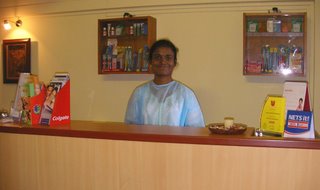
When I was checking out of the Perak Hotel, one of the staff asked me, “Happy?” I was baffled. At first, I thought, I’m generally happy and today, on a scale of 1-10, it would probably be an 8 or 9. Then I realized she might be asking, “Were you happy with your room?” Or it could have been, “Are you enjoying your stay in Singapore?” Because I had no idea how to reply, I just said, “I don’t speak Singlish.”
Singlish would be a good language to learn. If I spoke it with my Japanese students, it would probably make communication easier. Simple. Direct.
For example, at restaurants or shops, I’m used to hearing, “May I help you?” On the telephone, some use a formal expression such as, “How may I be of assistance?” In Singlish, the question is, “What do you want?” Simple. Direct.
Kaori also told me of the prevalence of the use of “can” and “can’t” as verbs. I thought she might be exaggerating. Then, after making an appointment with a dentist (a whole other story), I wanted to change the time of my appointment so called the office and asked, “Would it be all right if I came at 4:30 instead of 4:00.” The response from the receptionist (in the photo) was “4:30 can.” Simple. Direct.

When I was checking out of the Perak Hotel, one of the staff asked me, “Happy?” I was baffled. At first, I thought, I’m generally happy and today, on a scale of 1-10, it would probably be an 8 or 9. Then I realized she might be asking, “Were you happy with your room?” Or it could have been, “Are you enjoying your stay in Singapore?” Because I had no idea how to reply, I just said, “I don’t speak Singlish.”
Singlish would be a good language to learn. If I spoke it with my Japanese students, it would probably make communication easier. Simple. Direct.
Wednesday, September 06, 2006
As Scene from Singapore
Having the chance to talk with a Chinese businessman/hypnotist, a Muslim "information officer," an Indian dentist, an Australian artist, and a Vietnamese pianist, among others - this is especially what made visiting Singapore such an amazing experience. The beauty of Singapore is in its people, with so many cultures living together in harmony.
The only other place I've been that was so intercultural was Hawaii, but even there I didn't see the mingling of cultures that I did in Singapore. Granted it's made up of little "villages" - Little India, Chinatown, and so on - and some residents may never venture much beyond their neighborhood. However, when one does venture, the colors and variety are extraordinary. In fact, I wasn't able to choose a single photo that would capture Singapore as a whole because the whole is so multi!
To recount just a few experiences I had, I'll start with one of the least expected - a trip to the dentist. On the 3rd day of my stay in Singapore, I drank something cold that brought excruciating pain to a tooth on the lower left side. From that point on, I had a nearly constant toothache, a tragedy in a place with such delectable food. For temporary relief, I went to a drugstore and got a tincture of clove, which pretty much numbed the whole left side of my mouth.
 The next day I was wandering around Little India and saw a sign with a big tooth. I took it as a sign! Rather timidly going up the stairs to the dental office, I was relieved when I opened the door and was greeted by a grinning Indian receptionist who was able to schedule me for an appointment later that afternoon. The dentist turned out to be a woman, very professional, who said I had the option of either root canal or having the tooth pulled, but it would be better to have it done when I returned to Japan. She loaded me up with antibiotics and painkillers, and, except for a slight case of diarrhea from the antibiotics, I was able to enjoy the rest of my stay, especially eating!
 Another much more pleasant experience was when my two Japanese friends and I were having high tea at a hotel. It was my first time to have high tea - a bit like brunch in the afternoon, with all sorts of little sandwiches, fruit, a chocolate fountain (yikes!), and, of course, tea. I felt like such a lady.

Then a piano started playing, and it was wonderfully exotic and familiar at the same time, flowing with arpeggios and cadences. The truly gifted pianist was a young man and, when he took a break, I went over to introduce myself. He turned out to be from Thailand and appreciated having a fan. I loved his music so much, I asked if he had a CD. He asked me where I was sitting and told me to wait. A few minutes later, he appeared with a CD entitled "Just Piano." I asked him how much it was, but he said that it was a present for me! When he went back to play, I enjoyed the music all the more because of his generosity. The name on the CD was simply Jonathan. I've done an Internet search for him but can't find any website for him. At least I'll always have the music to remind me of my delightful high tea in Singapore.
Tuesday, September 05, 2006
Perak Hotel and Subways in Singapore
For the low-budget traveler who wants to be in the midst of Singapore, with all the sights, smells, and sounds of India, Perak Hotel (formerly Perak Lodge) is a great place to stay. The staff is extremely warm and accommodating. For example, when my roommate and I wanted to check out later than the hours posted, they graciously let us keep our bags in the room until we were ready.

The hotel is in the midst of Little India, a truly colorful place to explore. I spent a couple of days, one with my friends and one alone, going through countless small shops selling Indian-style clothing, earrings, and sandals, as well as spices and food. Within a short distance of the hotel are both a mosque and a Hindu temple, which permit visitors. Naturally, there are restaurants all over, and I was able to have Indian food of various kinds for five days in a row!
 As for the hotel, the rooms were a bit cramped (not large enough to do yoga in), but not uncomfortable. Some of the facilities in our rooms, such as the shower (with water not as hot as it might be) and air conditioner (which was difficult to adjust to a comfortable temperature), were not in the best working condition, but with no major problems.
My roommate was bothered by the noise of the adjoining bars on the weekends, which stayed open until 2 a.m. One apparently was playing Indian music all hours. (They didn't bother me since I live in an apartment on a busy street so am used to noise.) At her request, the staff moved us to a quieter room on the other side.
 Breakfast, with a huge fruit bowl and orange juice, is available in a small pleasant dining area from 7:00 - 10:00 a.m. Besides bread (including whole wheat), jam, peanut butter, honey, and cereal, there are hot dishes, sometimes eggs and sometimes noodles. The coffee and tea are both instant. One morning, at the tables around us, I heard at least 4 different languages being spoken by the various guests!
Had I known the hotel has its own wireless Internet set-up, I would have taken my laptop. It wasn't a problem, though, since less than a block away were at least 3 Internet cafes, charging $3 an hour, so I was able to check on my email. What's more, it was only 3-4 blocks from the subway station, so we could easily get around town, especially since my friend, Kaori, had bought us subway passes that only needed to be tapped at the ticket gate.
The subways in Singapore are so much more spacious than those in Japan, but just as clean. Electronic signs signal when the next train is due to arrive. People are generally courteous, standing at one side to let others off before getting on. For passengers who are standing, there are poles in the center to hold onto, so one can be near the doors and not treading on the toes of those sitting.
There are about 7 subway lines, and with all the escalators and long corridors, some of the stations can be a bit confusing to navigate. However, with a variety of artwork all over, even getting lost in the station can be pleasant.

Subscribe to:
Posts (Atom)